
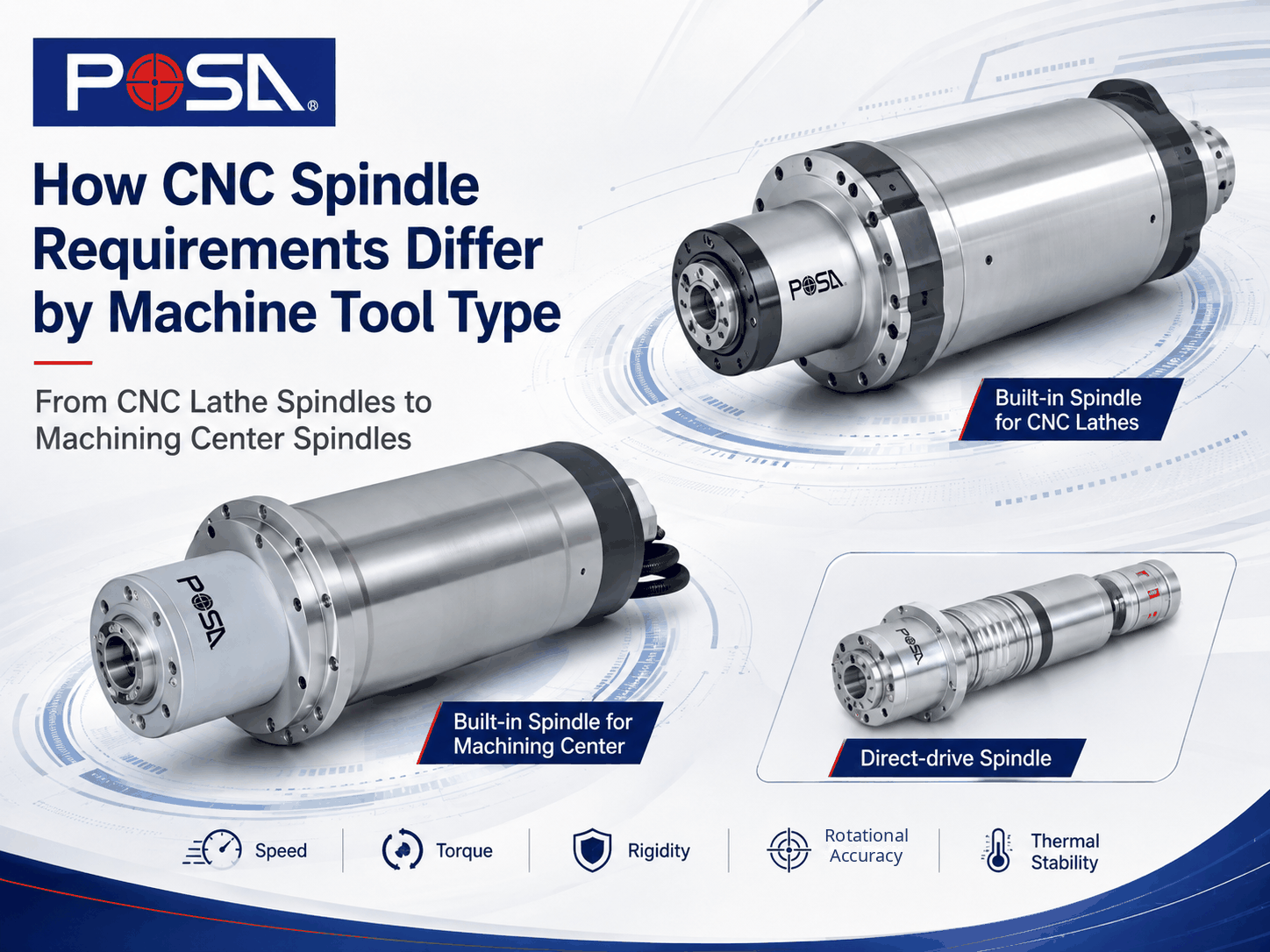
At POSA MACHINERY CO., LTD., we develop and manufacture precision spindles for different machine tool applications, including CNC lathes, machining centers, grinding machines, boring and milling machines, and turning and milling centers. A CNC spindle should not be evaluated by maximum RPM or motor power alone. Its configuration must match the spindle's mechanical function, machining load, accuracy requirements, operating range, thermal conditions, and machine interface.
1. Why Do CNC Spindle Requirements Differ by Machine Tool Type?
The main reason is that a spindle performs a different mechanical function depending on the machine tool.
In a CNC lathe, the spindle rotates and supports the workpiece while the cutting tool moves along programmed machine axes. In a machining center, the spindle holds and rotates the cutting tool for processes such as milling, drilling, and tapping.
Grinding machines place greater emphasis on stable grinding-wheel rotation and vibration control. Boring and milling machines may also require the spindle to maintain rigidity and accuracy while an extendable boring shaft operates farther from the machine structure.
These differences mean that the same spindle priorities cannot simply be applied to every machine tool. One application may place greater emphasis on rotational speed, while another may require more attention to rigidity, torque, rotational accuracy, vibration behavior, or thermal stability.
- The machine tool's function determines the spindle's primary mechanical role.
- CNC lathe spindles and machining center spindles perform different mechanical tasks.
- Spindle suitability should not be judged by maximum RPM, power, or one isolated specification.
- Speed, torque, rigidity, accuracy, vibration, and thermal behavior should be evaluated according to the application.
2. Which CNC Spindle Requirements Change Most by Machine Tool Type?
Although precision machine spindles share many common engineering considerations, the required balance between individual characteristics changes according to the machine and machining process.
Spindle Speed
High rotational speed can be important for small-diameter cutting tools, high-speed milling, drilling, finishing, and some grinding processes.
Other applications may operate at lower speeds but require stronger cutting capability under load. This is why maximum RPM alone does not determine whether a spindle is suitable for a machine.
Torque and Power
Torque and power influence how the spindle performs as cutting resistance increases.
Heavy cutting, larger tools, difficult-to-machine materials, and certain turning or boring operations may require a different speed-to-torque balance from high-speed finishing.
Rigidity
Rigidity affects how well the spindle structure resists deformation under machining loads. Adequate rigidity supports stable cutting, vibration control, surface quality, and dimensional consistency.
Rotational Accuracy and Vibration
Runout, dynamic balance, bearing configuration, assembly accuracy, and vibration all influence spindle rotational behavior.
Their relative importance varies by process, but they become particularly important in precision turning, grinding, and high-accuracy machining applications.
Thermal Stability
Bearing friction and motor operation generate heat during spindle operation. Higher machining loads and extended operating cycles can further increase spindle temperature.
Thermal management should therefore be evaluated together with spindle structure, bearing configuration, lubrication, cooling, speed, and actual operating conditions.
Tool or Workpiece Interface
A CNC lathe spindle must integrate with the machine's workholding arrangement. A machining center spindle must support the required cutting-tool interface and, where automatic tool changing is required, integrate correctly with the machine's tool-clamping and tool-change mechanism.
- Speed and torque must be balanced according to the machining process.
- Rigidity and vibration control directly affect machining stability.
- Thermal management should be evaluated together with bearings, lubrication, and spindle structure.
- Tool or workpiece interfaces are part of the spindle specification, not an afterthought.
3. CNC Lathe Spindle Requirements: Rigidity, Rotational Accuracy, and Workpiece Stability
For a CNC lathe spindle, the workpiece is the rotating element.
The spindle therefore needs to support stable workpiece rotation while resisting loads generated during turning. Rigidity, rotational accuracy, bearing support, workholding configuration, operating speed, machining load, and thermal behavior all need to be considered as part of the spindle system.
POSA's CNC lathe spindle product range includes:
- Built-in Spindle for CNC Lathes
- CNC Lathe Spindle Accessories Headstock & Tailstock for CNC Turning Machines
- Belt-drive Spindle for CNC Lathes
For the CNC lathe spindle range described on the official POSA product page, nose runout is controlled within 0.005 mm.
POSA also provides customizable headstock and tailstock dimensions and specifications according to application requirements. Certain belt-drive spindle functions can also be customized according to machine requirements.
These examples demonstrate why CNC lathe spindle specification should extend beyond RPM. Spindle structure, workholding arrangement, bearing design, rigidity, accuracy targets, and actual cutting conditions all contribute to stable workpiece rotation.
- Rigidity: Supports stable turning under machining loads.
- Rotational accuracy: Helps maintain consistent machining results.
- Workpiece stability: Supports stable rotation of the workholding system.
- Torque and power: Must correspond to actual cutting conditions.
- Thermal stability: Helps reduce the influence of temperature changes during extended operation.
4. Machining Center Spindle Requirements: Speed, Tool Stability, and Cooling
A machining center spindle performs a different role because it rotates the cutting tool rather than the workpiece.
Depending on machine configuration, the spindle may support milling, drilling, tapping, and other machining operations. Speed, torque, rigidity, rotational accuracy, vibration, tool interface, lubrication, and thermal control therefore need to be balanced according to the intended application.
POSA's Spindle for Machining Center range includes:
- Built-in Spindle for Machining Center
- Tapping Center Spindle
- Direct-drive Spindle
- Belt-drive Spindle
- Box-Type Gear Spindle
These configurations address different machine and machining requirements rather than representing a simple performance hierarchy.
High-speed machining may place greater emphasis on rotational speed, balance, lubrication, and thermal stability, while heavier cutting conditions may require greater attention to torque and structural rigidity.
Thermal management also varies according to spindle design and operating conditions. Cooling approaches may include air, oil, or liquid cooling.
Oil-air lubrication, by contrast, is primarily a controlled bearing-lubrication method that can also help limit friction-related heat generation.
Therefore, oil-air lubrication is not simply another name for a spindle cooling system. Cooling and lubrication should be evaluated together as part of the spindle's overall operating and thermal-management requirements.
For several POSA machining-center spindle configurations, including tapping center, direct-drive, belt-drive, and box-type gear spindles, the official product information specifies runout within 0.005 mm and dynamic balancing below G1.
- Speed and torque should be balanced according to the machining process.
- Tool rotation stability, rigidity, and low vibration are important performance considerations.
- Tool-interface and ATC compatibility should be confirmed where automatic tool changing is required.
- Cooling and lubrication are related but technically different spindle requirements.
- Thermal stability becomes increasingly important during extended machining cycles.
5. What Requirements Change for Grinding, Boring & Milling, and Turning-Milling Spindles?
Grinding Spindles: Rotational Stability and Vibration Control
Grinding performance is particularly sensitive to spindle rotational behavior because grinding-wheel motion directly affects surface quality and dimensional accuracy.
Important considerations include runout, vibration, dynamic balance, bearing performance, rigidity, and thermal stability.
POSA's Spindle for Grinders (Grinding Machines) range includes:
- Built-in Grinder Spindle
- Surface Grinding Spindle
- Internal Grinder Spindle
- Tool Cutter Grinder Spindles
For the Surface Grinding Spindle, Internal Grinder Spindle, and Tool Cutter Grinder Spindles listed on the official POSA website, runout is specified within 0.005 mm, with dynamic balancing below G0.4.
Boring & Milling Spindles: Rigidity During Spindle Extension
An extendable boring spindle introduces a different structural challenge because the spindle must remain stable as the boring shaft extends.
Spindle diameter, extension length, rigidity, straightness, vibration behavior, and rotational accuracy therefore need to be considered together.
For one POSA Spindles for Boring & Milling Machine configuration with a spindle diameter of 130 mm, the official product information lists:
- 700 mm telescopic stroke
- 0.01 mm straightness when fully extended
- Spindle runout within 0.02 mm
These specifications apply to the referenced configuration and illustrate the structural requirements that may become important in long-extension boring and milling applications. They should not be applied to every spindle model.
Turning-Milling Spindles: Balancing Multiple Machining Functions
Turning and milling centers combine multiple machining functions within one machine platform, so spindle requirements depend heavily on machine architecture and the spindle's role within the system.
POSA's Spindle for Turning and Milling Centers category includes:
- Swivel Head Spindle
- High Speed Built-in Spindle
Depending on the application, these spindles may need to balance speed, torque, rigidity, accuracy, thermal behavior, positioning requirements, and machine integration.
- Grinding spindles place greater emphasis on rotational accuracy, vibration, and dynamic balance.
- Boring and milling spindles introduce additional structural requirements when the spindle extends.
- Turning-milling spindle requirements depend on the combination of machining functions and machine architecture.
6. CNC Spindle Requirements by Machine Tool Type: Quick Comparison
The following table summarizes how spindle priorities commonly change according to the machine tool's primary function.
| Machine Tool Type | Primary Spindle Role | Requirements Commonly Evaluated |
|---|---|---|
| CNC Lathe | Rotates and supports the workpiece | Rigidity, rotational accuracy, torque, workholding stability, thermal stability |
| Machining Center | Rotates the cutting tool | Speed, torque, rigidity, tool interface, vibration control, cooling |
| Grinding Machine | Drives the grinding wheel | Rotational accuracy, low vibration, dynamic balance, thermal stability |
| Boring & Milling Machine | Supports boring and milling, including extended spindle operation | Rigidity, extension stability, torque, vibration control, rotational accuracy |
| Turning & Milling Center | Supports combined machining functions | Speed, torque, rigidity, accuracy, thermal behavior, system integration |
There is no single CNC spindle specification that is best for every machine tool. The appropriate spindle configuration is the one whose performance characteristics match the spindle's mechanical role and the machine's actual operating conditions.
7. What Application Information Should You Prepare When Discussing a CNC Spindle with POSA?
When discussing a spindle requirement with POSA, clearly defined application information helps us understand what the machine actually needs.
POSA provides precision spindle products and spindle solutions for different machine-tool applications. Depending on product category and application requirements, specifications, dimensions, functions, or spindle configurations may also be customized to suit machine requirements.
Machine Tool Type and Spindle Function
Start by defining how the spindle will be used:
- CNC turning
- Milling
- Drilling
- Tapping
- Grinding
- Boring and milling
- Combined turning and milling
Workpiece and Machining Conditions
- Workpiece material
- Tool or workholding arrangement
- Cutting conditions
- Expected machining load
- Production cycle
Required Performance
- Operating speed range
- Torque and power requirements
- Accuracy and runout targets
- Rigidity requirements
- Interface requirements
Installation and Thermal Requirements
- Installation dimensions
- Available machine space
- Tool or workholding interface
- Tool-change requirements
- Cooling method
- Lubrication method
- Continuous operating conditions
A spindle discussion does not have to begin with an assumed spindle model. Starting with the machine tool type, spindle function, and actual machining conditions provides a clearer basis for discussing available POSA spindle configurations and applicable customization options.
8. FAQ: CNC Spindle Requirements
Is a CNC lathe spindle different from a machining center spindle?
Yes. A CNC lathe spindle primarily rotates and supports the workpiece, while a machining center spindle primarily rotates the cutting tool.
Because their mechanical roles differ, the relative importance of workholding, tool interface, speed, torque, rigidity, rotational accuracy, and machine integration also changes.
Can the same CNC spindle be used for different machine tools?
Not automatically.
A spindle must match the machine structure, drive arrangement, operating speed, machining load, interface, accuracy requirements, bearing configuration, lubrication, cooling, and actual operating conditions.
Some spindle configurations may be customized for different applications, but compatibility should be evaluated according to the machine requirements.
What is more important in a CNC spindle: speed or torque?
Neither is universally more important.
High-speed machining may place greater emphasis on rotational speed, balance, bearings, lubrication, and thermal control. Heavy cutting may require greater torque, load capability, and structural rigidity.
The correct balance depends on the machine tool and machining process.
Why are rigidity and thermal stability important in machine spindles?
Rigidity helps a spindle resist deformation under machining loads and supports stable cutting.
Thermal stability helps reduce the influence of temperature change and thermal growth on spindle position and machining consistency.
What information should I provide when discussing a spindle requirement with POSA?
We recommend providing as much of the following information as possible:
- Machine tool type
- Spindle function
- Machining process
- Workpiece material
- Cutting conditions
- Required speed range
- Torque and power requirements
- Accuracy or runout targets
- Tool or workholding interface
- Installation dimensions
- Cooling and lubrication requirements
- Operating cycle
This information helps POSA understand the actual application before discussing an available or customized spindle configuration.
Looking for a CNC Spindle That Matches Your Machine Requirements?
At POSA MACHINERY CO., LTD., we provide spindle products and solutions for CNC lathes, machining centers, grinding machines, boring and milling machines, and turning and milling centers.
If you are developing a machine tool or evaluating a spindle configuration, provide your machine type, machining conditions, operating range, accuracy requirements, interface, installation dimensions, and thermal-management requirements. We can then discuss relevant POSA spindle products and applicable customization options.
Contact POSA