
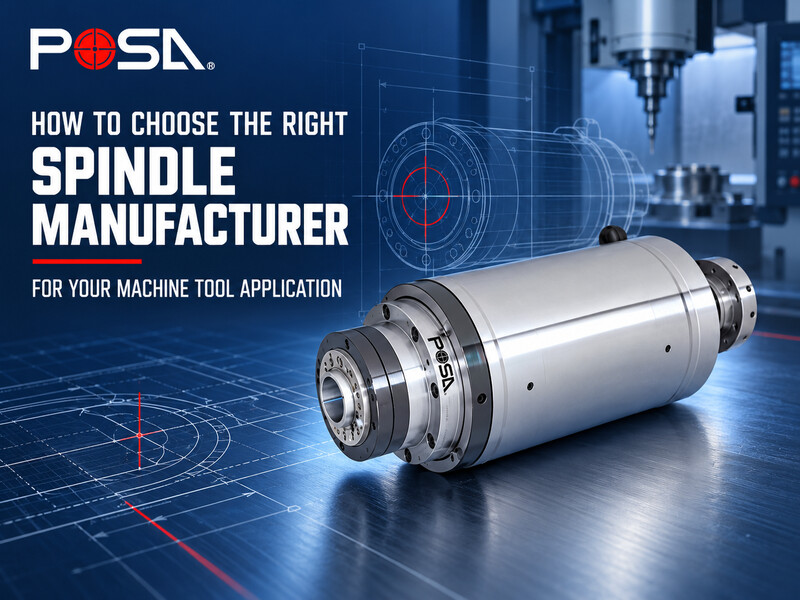
The right spindle manufacturer should be able to connect your machining requirements with an appropriate spindle configuration—not simply quote maximum speed, motor power, and price.
Selection should be based on the machining process, operating load, accuracy target, duty cycle, interface, cooling conditions, and installation requirements of the complete machine.
POSA MACHINERY CO., LTD. provides spindle solutions for CNC lathes, machining centers, grinding machines, turning and milling centers, and boring and milling machines. This guide explains how machine tool builders, system integrators, and purchasing teams can evaluate a spindle supplier and prepare for a productive technical discussion.
1. What Should You Look for in a Spindle Manufacturer?
The right spindle manufacturer should be able to translate your machining requirements into a suitable spindle configuration. When comparing suppliers, focus on six areas: application experience, product range, engineering capability, customization, quality verification, and technical communication.
For machine tool builders, a CNC spindle manufacturer should be able to discuss both spindle performance and machine integration. A supplier should not recommend a model based only on the requested RPM. The discussion should also cover the machine type, machining process, material, operating load, accuracy target, available installation space, and production conditions.
POSA was established in 1994 and has developed a product range for several major machine tool categories. We evaluate customer requirements before discussing an applicable standard product or customized configuration. Learn more about our spindle development background and engineering approach .
- Look beyond maximum speed, motor power, and purchase price.
- Confirm that the manufacturer understands machine integration as well as spindle specifications.
- Evaluate application experience, engineering capability, customization, quality verification, and communication together.
2. Can the Manufacturer Match the Spindle to Your Machine Application?
A spindle manufacturer should have products and experience that correspond to the machine being developed. Each application creates different requirements for speed, torque, rigidity, accuracy, transmission, sealing, cooling, and installation.
POSA’s machine tool spindle product range covers five principal application categories:
| Machine Application | Main Spindle Considerations |
|---|---|
| CNC lathe | Workholding arrangement, through-hole capacity, torque, rigidity, speed, and headstock integration |
| Machining center | Tool interface, speed, torque, tool change, acceleration, coolant delivery, and cutting load |
| Grinding machine | Rotational accuracy, vibration, bearing configuration, thermal behavior, and grinding wheel requirements |
| Turning and milling center | Combined operations, axis arrangement, motor configuration, and machine integration |
| Boring and milling machine | Rigidity, spindle extension, straightness, runout, and heavy machining conditions |
Machine category alone does not determine the correct spindle. For example, a machining center designed for high-speed, light cutting has different spindle requirements from one intended for lower-speed, heavy material removal.
When discussing an application with us, first identify whether the spindle drives the workpiece, a cutting tool, or a grinding wheel, and then provide the expected load and operating conditions.
- Does the manufacturer offer a spindle category for your machine type?
- Can the supplier discuss the actual machining load and duty cycle?
- Does the recommended configuration match what the spindle will drive?
3. Which Spindle Specifications Should Be Evaluated Together?
Spindle specifications are interconnected. Changing the required speed, torque, power, bearing arrangement, lubrication, or cooling can affect other aspects of the spindle design. Individual catalog values should therefore not be evaluated in isolation.
Speed, Torque, and Power
Maximum RPM does not describe spindle performance across the complete operating range. High-speed machining with small tools and heavy cutting with larger tools require different speed-and-torque characteristics. Normal production conditions are therefore just as important as maximum values.
Accuracy and Rigidity
Runout is an important spindle specification, but it does not independently determine final part accuracy. Machine structure, tooling, workholding, alignment, cutting conditions, and thermal behavior also affect machining results.
Selected POSA CNC lathe and machining center spindle products specify runout within 0.005 mm. The applicable value must be confirmed according to the individual product series and configuration.
The spindle must also provide sufficient rigidity for the expected axial and radial loads. Bearing arrangement, shaft structure, housing, preload, and machine installation all contribute to operating stability.
Interface and Machine Integration
For machining centers, the tool interface must correspond to the toolholder and tool-changing system. For CNC lathes, the spindle must match the intended chuck, collet, bar capacity, or other workholding arrangement. These interfaces affect the surrounding machine design and should be confirmed early in the development process.
Lubrication, Cooling, and Duty Cycle
Continuous and intermittent duty cycles create different thermal loads. Actual temperature behavior also depends on speed, machining load, motor configuration, lubrication, cooling-medium stability, and the surrounding machine structure. The cooling method should therefore be matched to the complete spindle application instead of being selected as an independent accessory.
- Evaluate the normal operating range—not only the maximum RPM.
- Consider speed, torque, power, rigidity, and duty cycle together.
- Confirm tool or workholding interfaces before finalizing the machine structure.
- Treat spindle accuracy as one part of the complete machine system.
4. Does the Manufacturer Offer the Customization Your Machine Requires?
A standard spindle is appropriate when its dimensions, performance range, interface, and functions already match the machine design. A customized spindle configuration may be necessary when the machine has specific installation restrictions, performance targets, functional requirements, or operating conditions.
Depending on the spindle series and confirmed project requirements, customization discussions may cover:
- Spindle, headstock, or tailstock dimensions
- Motor selection and configuration
- Speed and torque requirements
- Tool-clamping functions
- Through-spindle coolant and ring spray
- Cooling arrangement and sensor integration
- Sealing and contamination protection
- Connections with surrounding machine components
POSA’s CNC lathe spindle range includes headstock and tailstock solutions whose dimensions and specifications can be customized according to customer requirements. Selected belt-drive CNC lathe spindles can also be configured with automatic tool clamping, through-spindle coolant, and ring spray functions.
For machining center spindles , customization availability varies by spindle type. Selected belt-drive products can be discussed in terms of dimensions and functions based on the machine requirements.
- Can a standard spindle meet the machine requirements?
- Which dimensions or functions genuinely require customization?
- Has each requested feature been confirmed for the applicable spindle series?
5. How Does the Manufacturer Verify Spindle Precision and Reliability?
When evaluating a precision spindle manufacturer, buyers should distinguish between engineering analysis performed during development and inspection performed on the assembled product. Both are important, but they serve different purposes.
Engineering Analysis During Development
Depending on the spindle and project, engineering analysis may address structural rigidity, thermal displacement, bearing and shaft behavior, lubrication and cooling requirements, and protection against coolant and contaminants.
POSA applies finite element analysis and thermal displacement analysis to relevant spindle development. For machining center spindle products, flow-field analysis is also used in the development of spindle-nose protection against coolant and contaminants.
Inspection and Operating Verification
Buyers should ask which inspection and operating checks apply to the selected product. Relevant checks may include:
- Runout measurement
- Dynamic balancing verification
- Vibration evaluation
- Temperature-rise testing
- Trial operation and final inspection
The applicable tests, acceptance criteria, and available documents should be confirmed for each spindle and project. A performance value shown for one product should not automatically be treated as a universal specification across the complete spindle range.
POSA established an intelligent spindle test laboratory in 2000 and has participated in spindle simulation laboratory cooperation with academic institutions. Selected POSA built-in spindle products also incorporate sensors that monitor conditions such as temperature rise and vibration. POSA’s intelligent spindle development is also documented on the external Taiwan Excellence product page .
- Separate engineering analysis from assembled-product inspection.
- Ask which tests and acceptance criteria apply to the selected spindle.
- Confirm whether the required inspection documents are available for the project.
- Do not generalize one model’s runout, balance, sensor, or cooling specifications to every POSA spindle.
6. What Should You Prepare Before Requesting a Quote?
A clear request helps a spindle supplier determine whether an existing model or a customized configuration should be discussed. Instead of providing only a maximum speed, describe the conditions under which the spindle will actually operate.
Machine and Application
- Machine type and machining process
- Workpiece material
- Tool size or workholding arrangement
- Expected cutting conditions
Performance Requirements
- Normal and maximum speed
- Required torque and power
- Accuracy and runout target
- Load, duty cycle, tolerance, and surface requirements
Integration Requirements
- Tool or workholding interface
- Available installation dimensions
- Motor, lubrication, and cooling conditions
- Coolant, sensors, and special functions
Project Information
- New machine or replacement application
- Expected order quantity
- Development schedule
- Required technical or inspection documents
When reviewing a technical proposal, check whether the supplier asks follow-up questions and explains why a particular configuration is recommended. A useful proposal should clearly identify confirmed specifications, assumptions, optional functions, and items that still require technical discussion.
We review the customer’s machine structure, machining conditions, and performance targets before discussing an applicable POSA product or custom spindle solution. Early communication can make it easier to coordinate installation dimensions, interfaces, cooling conditions, and required functions before the machine design is fixed.
- Provide normal operating conditions as well as maximum values.
- State accuracy targets together with the machining and machine requirements.
- Identify installation restrictions and required functions early.
- Evaluate the supplier’s technical reasoning—not only the quoted specifications and price.
7. FAQ About Choosing a Spindle Manufacturer
What is the difference between a standard spindle and a custom spindle?
A standard spindle has predefined dimensions, interfaces, functions, and performance specifications. A customized spindle configuration adjusts applicable elements to match a particular machine or process. The available level of customization depends on the spindle series and must be technically confirmed.
How do I determine the required spindle speed and torque?
Start with the machining process, workpiece material, tool size, cutting parameters, and required cycle time. Maximum RPM alone is insufficient because the spindle must provide suitable torque and power across the range in which the machine will actually operate.
What quality checks should I ask a spindle manufacturer about?
Ask which inspections and operating verifications apply to the selected spindle. Relevant items may include runout measurement, dynamic balancing verification, vibration evaluation, temperature-rise testing, trial operation, and final inspection. Acceptance criteria and available documents should be confirmed for the individual project.
When should a spindle manufacturer become involved in machine development?
Ideally, the spindle manufacturer should be consulted before installation dimensions, motor arrangement, cooling system, tooling interface, and surrounding machine structure are finalized. Early technical communication helps identify integration requirements before design changes become more difficult.
Discuss Your Machine Tool Spindle Requirements with POSA
The right spindle supplier should be able to connect your machining requirements with a technically appropriate and clearly defined spindle configuration.
POSA MACHINERY provides spindles for CNC lathes, machining centers, grinding machines, turning and milling centers, and boring and milling machines. We discuss applicable standard products and customized configurations according to the selected product series and confirmed machine requirements.
If you are developing a new machine tool or reviewing an existing spindle configuration, prepare your application, performance, and installation information and contact us to discuss the technical requirements of your project.
Contact POSA