BLOG

In modern CNC machining, precision, stability, and efficiency all depend on one critical component: the spindle. Whether the operation involves milling, drilling, or tapping, the spindle directly determines machining performance.
At POSA Machinery, we have extensive experience working with machine tool builders across industries such as aerospace, automotive, and energy equipment. In our experience, understanding how a machining center spindle works is essential for selecting the right solution and achieving consistent machining results.
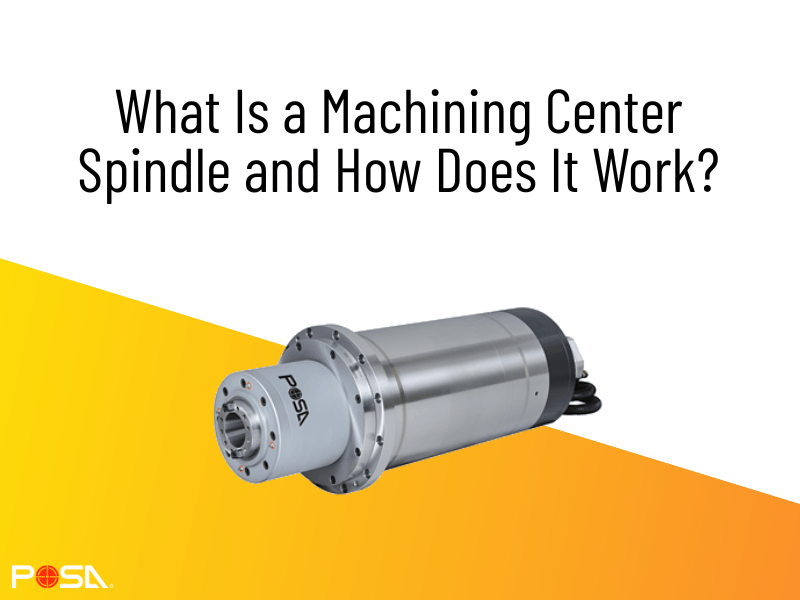
A machining center spindle is the core component of a CNC machining center that drives the cutting tool. It provides the rotational motion and cutting force required to remove material from a workpiece.
Unlike a lathe spindle, which rotates the workpiece, a machining center spindle rotates the cutting tool while the workpiece is fixed or moves along multiple axes.
A typical machining center spindle is responsible for:
In many applications, machining center spindles can also function as drill spindles, depending on the required speed, torque, and machining conditions. This makes them highly versatile across different manufacturing processes.
A machining center spindle operates by converting motor power into rotational motion, which drives the cutting tool.
The basic working principle involves:
Power is delivered from the motor to the spindle through different drive systems, such as:
Each system offers different advantages in terms of speed, torque, and rigidity.
The spindle holds the cutting tool using a tool interface such as BT, CAT, or HSK. Once clamped, the spindle rotates the tool at the required speed to perform machining operations.
The stability of the tool clamping system directly affects machining accuracy and surface finish.
As the spindle rotates, the cutting tool engages with the workpiece to remove material. The spindle must maintain stable rotation and minimize vibration to ensure consistent cutting quality.
Depending on the application, the spindle may perform:
This is why machining center spindles are often used in applications that require both milling and drilling functions.
During high-speed machining, heat is generated inside the spindle. Advanced spindle designs use:
to maintain thermal stability and prevent deformation.
Thermal control is essential to ensure consistent machining accuracy during long production cycles.
From POSA’s experience in spindle development, machining center spindles can be categorized into several main types:
Each type is designed to meet different machining requirements, depending on material, cutting conditions, and machine configuration.
High-precision spindles minimize runout and ensure stable cutting performance.
Reduced vibration leads to better surface quality.
Optimized spindle speed and torque improve cutting efficiency and cycle time.
Stable spindle performance reduces tool wear and extends tool lifespan.
At POSA Machinery, we focus on developing spindle systems that provide:
Our Spindle for Machining Center series is designed to support a wide range of applications, from high-speed precision machining to heavy-duty cutting operations.
A machining center spindle is more than just a rotating component—it is the foundation of machining performance in CNC operations. From milling and drilling to tapping, the spindle plays a critical role in ensuring precision, efficiency, and reliability.
Understanding how a machining center spindle works helps manufacturers select the right configuration for their applications and improve overall machining performance.
Looking for the right spindle solution for your machining needs?
At POSA Machinery, we provide a wide range of machining center spindles designed for high precision, durability, and performance across various industries.
Explore our machining center spindle solutions or contact us to discuss your specific application requirements.
In the next article, we will explore how to choose the right machining center spindle for different applications, including key factors such as speed, torque, and spindle configuration.