
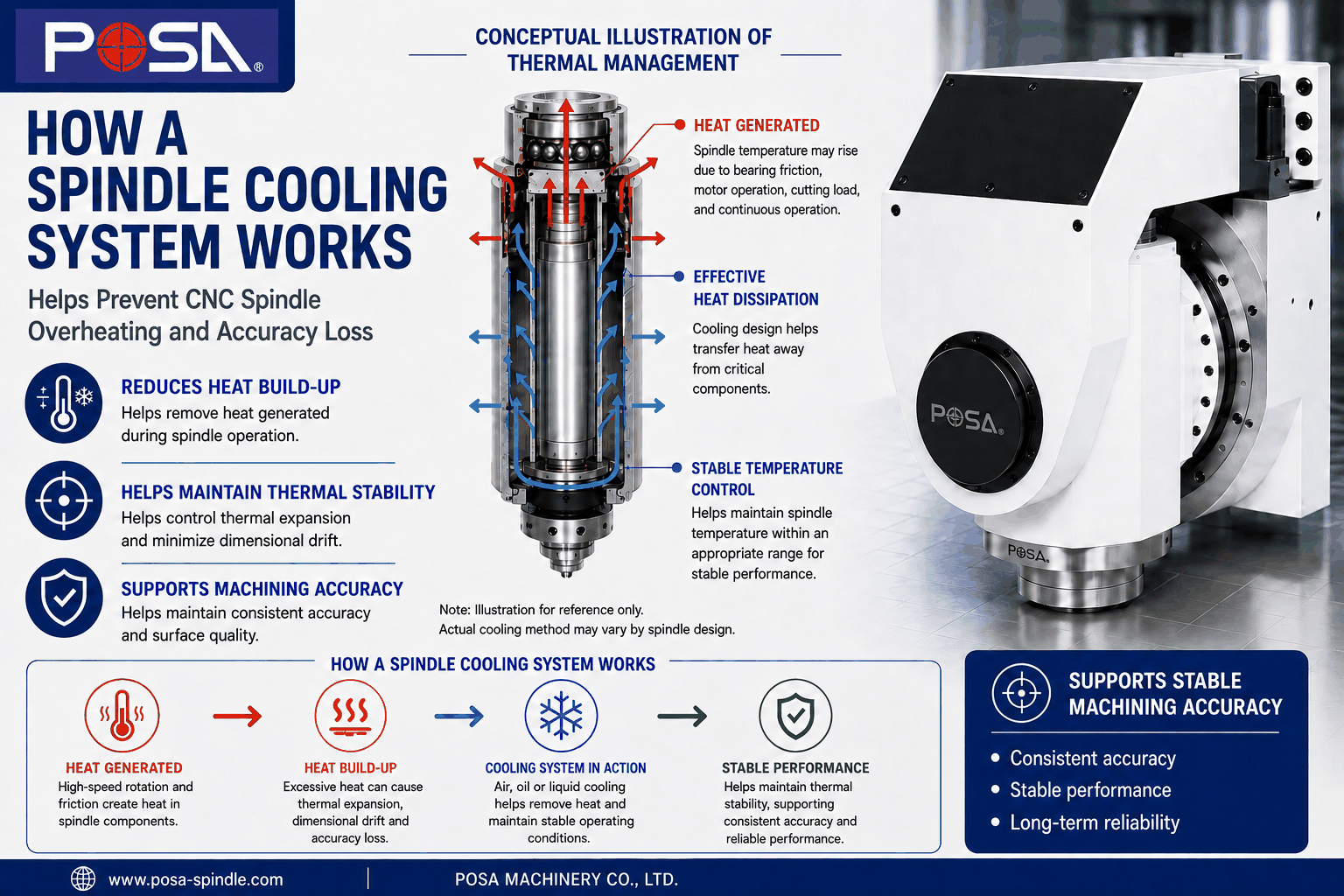
Spindle overheating can turn stable machining into dimensional drift, vibration, and inconsistent finishes. This guide explains how spindle cooling, lubrication, and thermal management work together—and what machine tool builders should define when evaluating spindle requirements.
In CNC machining, a certain amount of spindle temperature rise is normal. The engineering challenge is not to eliminate heat completely, but to keep spindle temperature sufficiently stable to limit the effect of thermal growth on machining accuracy.
At POSA MACHINERY CO., LTD., we design and manufacture machine tool spindles for CNC lathes, machining centers, grinding machines, boring and milling machines, and turning and milling centers. In spindle engineering, cooling requirements need to be considered together with spindle structure, bearing configuration, lubrication, operating speed, and actual application conditions.
For machine tool builders, understanding where spindle heat comes from and how thermal stability affects machining provides a better basis for defining an appropriate spindle configuration.
1. Why Does a CNC Spindle Generate Heat?
A CNC spindle naturally generates heat when its bearings, motor, and rotating components operate under speed and load. The key issue is whether the resulting temperature can remain within a stable operating range.
Two important internal heat sources are bearing friction and, in built-in motor spindles, motor losses. Machining load can increase thermal demand, while extended operating cycles allow temperature rise to develop over a longer period.
It is therefore important to distinguish between heat generation and heat accumulation. Insufficient heat removal does not create the original heat, but it can make stable operating temperature more difficult to maintain.
| Factor | Thermal Effect |
|---|---|
| Bearing friction | Generates heat as bearings rotate under speed and load. |
| Built-in motor operation | Adds motor-generated heat within the spindle structure. |
| Machining load | Can increase spindle load and operating temperature. |
| Continuous operation | Allows temperature rise to develop over a longer period. |
| Insufficient heat removal | Makes stable operating temperature more difficult to maintain. |
- Some spindle temperature rise during operation is normal.
- Bearing friction and motor losses are important internal heat sources.
- Machining load and operating duration influence thermal demand.
- The main concern is temperature stability, not simply whether the spindle becomes warm.
2. How Does CNC Spindle Overheating Affect Machining Accuracy?
Excessive or unstable spindle temperature can cause thermal growth, which may change spindle position or geometry and contribute to dimensional variation.
As spindle temperature rises, spindle components expand. If this thermal growth becomes excessive or unstable, it may alter the relationship between the spindle, tool, and cutting point.
Possible effects include:
- Dimensional drift
- Changes in spindle runout
- Increased vibration
- Unstable surface finish
- Changes in tool or cutting-point position
- Reduced consistency during long production cycles
Cooling cannot guarantee machining accuracy by itself because machine structure, cutting conditions, tooling, bearings, and other factors also influence final machining results. However, stable spindle temperature can help reduce one important source of dimensional variation.
- Excessive or unstable temperature may contribute to thermal deformation.
- Thermal growth can influence dimensional consistency and surface quality.
- Long production cycles make spindle thermal stability particularly important.
- Cooling supports accuracy by helping control temperature-related variation; it does not independently guarantee machining accuracy.
3. What Is a Spindle Cooling System and What Does It Do?
A spindle cooling system helps control heat accumulation and maintain a more stable spindle operating temperature. Its purpose is not to eliminate all heat generation.
Depending on spindle design and application, thermal-control approaches may include:
- Air cooling
- Oil cooling
- Liquid cooling
The appropriate cooling method depends on spindle structure, motor arrangement, bearing configuration, operating speed, machining load, and duty cycle.
Higher cooling capacity is not automatically better. Effective thermal management depends on matching the cooling method, capacity, flow, and temperature control to the actual spindle design and operating requirements.
This is why cooling should be treated as part of the overall spindle system rather than as a universal accessory applied identically to every spindle.
4. How Do Cooling and Lubrication Work Together in Spindle Thermal Management?
Cooling controls or transfers heat, while lubrication primarily reduces bearing friction and supports proper bearing operation. Both influence spindle thermal behavior, but they are not the same system.
Oil-air lubrication, for example, is a controlled bearing-lubrication method commonly used in high-speed spindle applications. It is not another name for spindle cooling.
By supplying lubricant efficiently and limiting unnecessary friction, oil-air lubrication can help reduce friction-related heat generation.
| System | Primary Function | Thermal Contribution |
|---|---|---|
| Air / oil / liquid cooling | Transfers or controls heat | Helps stabilize spindle operating temperature |
| Bearing lubrication | Reduces friction and supports bearing operation | Helps limit friction-related heat generation |
| Oil-air lubrication | Delivers controlled lubricant to bearings | Supports low-friction operation at higher speeds |
- Cooling and lubrication serve different primary functions.
- Oil-air lubrication is a bearing lubrication method.
- Proper lubrication can help reduce friction-related heat, while cooling manages heat within the spindle system.
5. Why Is Stable Spindle Temperature Important During Long Production Cycles?
During long machining cycles, consistent spindle temperature is important because dimensional stability must be maintained after warm-up as well as during extended operation.
During startup, spindle temperature may still be changing. As production continues, bearings, motor components, spindle housing, and surrounding machine structures move toward their operating thermal condition.
If temperature continues changing significantly rather than becoming relatively stable, dimensional consistency may become more difficult to maintain.
Stable spindle temperature is especially relevant when:
- Production cycles continue for several hours
- Tight dimensional tolerances must be maintained
- High spindle speeds are used
- Surface-finish consistency is important
- The machine operates continuously
The goal is therefore not simply to achieve the lowest possible temperature. It is to maintain a controlled and predictable thermal condition.
- Long production cycles make thermal consistency more important than short-term temperature readings.
- Stable operating temperature can help limit temperature-related changes in spindle geometry.
- Maximum cooling is not necessarily the goal; controlled thermal behavior is.
6. What Should Machine Tool Builders Consider for Spindle Thermal Management?
Machine tool builders should define spindle thermal requirements according to actual operating conditions rather than treating cooling capacity as an isolated specification.
| Evaluation Factor | Why It Matters |
|---|---|
| Operating speed | Higher speed can increase bearing and motor thermal load. |
| Machining load | Higher load can increase spindle temperature rise. |
| Duty cycle | Continuous operation increases the importance of thermal stability. |
| Motor configuration | Built-in motors introduce motor-generated heat within the spindle. |
| Bearing configuration | Influences friction, accuracy, rigidity, speed capability, and thermal behavior. |
| Lubrication method | Influences bearing friction and operating stability. |
| Cooling requirements | Define how spindle heat needs to be managed. |
| Machine structure | Spindle thermal movement interacts with the surrounding machine structure. |
At POSA, spindle structure, bearing configuration, lubrication, cooling requirements, operating speed, and application conditions are evaluated as related design factors rather than isolated specifications.
7. How Does POSA Address Thermal Stability in Machine Tool Spindles?
POSA evaluates spindle thermal requirements according to spindle type, structure, operating conditions, and application requirements rather than applying one cooling specification across every spindle product.
POSA's machine tool spindle range includes products for:
- Spindle for CNC Lathe
- Spindle for Machining Center
- Spindle for Grinders (Grinding Machines)
- Spindles for Boring & Milling Machine
- Spindle for Turning and Milling Centers
Because these spindle types differ in structure and operating requirements, cooling requirements cannot be generalized across the complete spindle range.
POSA Product Example: High Speed Built-in Spindle
One application-specific example is POSA's High Speed Built-in Spindle , listed under Spindle for Turning and Milling Centers.
- Maximum Speed: 15,000 RPM
- Cooling Method: Oil
- Surround Coolant System: Yes
- Minimum Spindle Cooling Requirement: 7,500 BTU/H
- Different spindle types have different thermal requirements.
- Cooling requirements should be matched to the actual spindle configuration.
- Product-specific cooling specifications should not be generalized across all spindle models.
8. FAQ: Spindle Cooling System and CNC Spindle Overheating
What causes CNC spindle overheating?
CNC spindle overheating may result from a combination of bearing friction, high operating speed, machining load, insufficient lubrication, bearing conditions, motor operation, inadequate heat removal, and extended operating cycles. The actual cause should be evaluated according to spindle design and operating conditions.
How does a spindle cooling system work?
A spindle cooling system helps remove or control heat within the spindle structure so the spindle can operate within a more stable temperature range. Depending on spindle design, air, oil, or liquid cooling may be used.
Does every high-speed spindle require oil cooling?
No. Cooling method depends on spindle structure, speed, motor configuration, bearings, power, load, and operating requirements. POSA's High Speed Built-in Spindle uses oil cooling, but that specification applies to that particular configuration rather than every high-speed spindle.
Is oil-air lubrication the same as spindle cooling?
No. Oil-air lubrication is primarily a bearing-lubrication method. It can help reduce friction-related heat generation, but it is technically different from a spindle cooling system.
Can increasing cooling capacity alone eliminate spindle thermal drift?
Not necessarily. Thermal behavior also depends on spindle structure, bearings, lubrication, motor configuration, operating load, cooling-medium stability, and machine structure. Cooling should therefore be matched to the overall spindle application rather than increased independently.
Discuss Your Spindle Requirements with POSA
If you are evaluating a spindle for a new machine tool or reviewing thermal requirements for a spindle application, preparing key operating information can provide a clearer basis for spindle configuration discussions.
Useful information includes spindle or machine-tool type, operating speed, machining load, duty cycle, accuracy requirements, lubrication conditions, cooling requirements, and installation conditions.
POSA MACHINERY CO., LTD. can discuss relevant spindle products and applicable customized spindle configurations according to the actual machine-tool application.
Contact POSA