BLOG

The demand for high-quality optical components continues to grow across industries such as consumer electronics, automotive lighting, medical devices, optical communication, and LED lighting. As optical lenses become more sophisticated and precision requirements continue to increase, manufacturers must pay close attention to every stage of the production process.
One of the most critical factors in optical lens manufacturing is the performance of the grinding spindle. Whether machining optical molds, glass lenses, acrylic lenses, or LED optical components, the spindle directly influences machining accuracy, surface quality, productivity, and overall manufacturing consistency.
At POSA Machinery, we understand that selecting the right grinder spindle involves much more than simply choosing a spindle with the highest rotational speed. Factors such as spindle rigidity, vibration control, thermal stability, and bearing performance all play important roles in achieving the precision required for optical applications.
Unlike general metal machining applications, optical lens processing places extremely high demands on surface quality and dimensional accuracy.
Even microscopic imperfections can affect:
Materials commonly used in optical applications include:
These materials often require ultra-precise grinding processes that demand stable spindle performance throughout the machining cycle.
For this reason, many optical processing machines utilize high-speed grinder spindles specifically designed to minimize vibration and maintain rotational accuracy.
A Built-in Grinder Spindle is a spindle design in which the motor rotor is integrated directly into the spindle shaft, eliminating the need for external transmission mechanisms such as belts or gears.
Unlike conventional spindle systems, built-in spindles offer direct power transmission between the motor and spindle shaft.
This design provides several advantages:
Because there are fewer mechanical transmission components, runout and transmission errors can be significantly reduced.
The direct-drive structure minimizes vibration generated by belts, pulleys, or gears.
Built-in spindle designs are ideal for high-speed grinding applications commonly found in optical lens manufacturing.
Stable spindle rotation helps produce smoother surfaces and better optical finishes.
For industries requiring extremely fine surface quality, such as LED and optical lens processing, built-in grinder spindles are often preferred over traditional spindle configurations.
Understanding the advantages of a built-in grinder spindle is only the first step. When selecting a spindle for LED and optical lens processing, manufacturers must evaluate a combination of performance characteristics rather than focusing on a single specification such as spindle speed.
In optical manufacturing, the final product quality is influenced by many factors working together. A spindle with excellent speed capability may still struggle to deliver consistent results if vibration levels are too high. Likewise, a spindle with outstanding rigidity may not achieve the desired surface quality if thermal stability is insufficient during long production cycles.
Because optical lenses are used to control, focus, or transmit light, even minor machining deviations can affect optical performance. As lens designs become increasingly sophisticated, spindle selection has become a critical part of maintaining product quality, production efficiency, and manufacturing consistency.
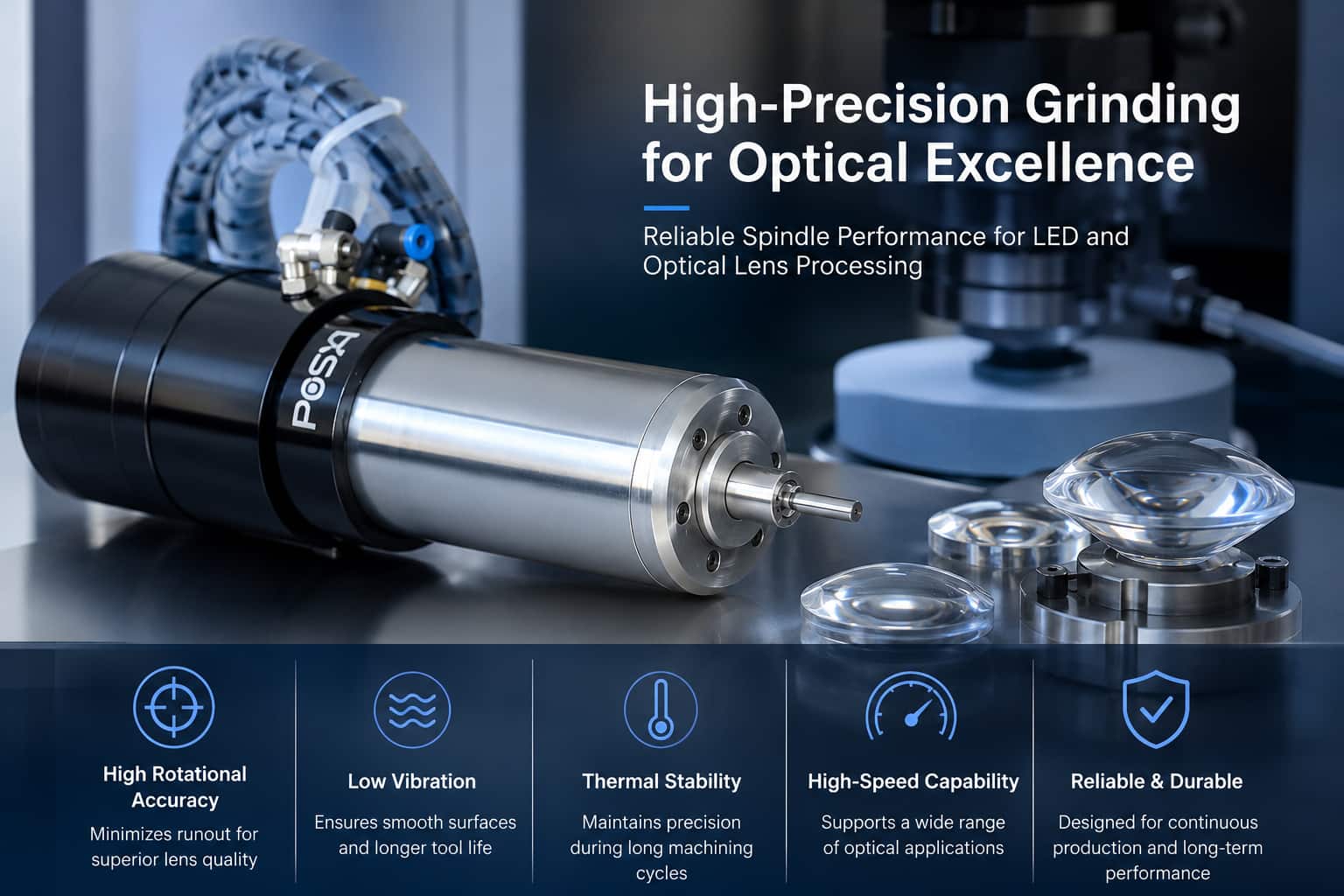
At POSA Machinery, we generally recommend evaluating grinder spindles from five key perspectives before making a selection.
| Evaluation Factor | Why It Matters in Optical Lens Processing |
|---|---|
| Rotational Accuracy & Runout | Determines lens geometry, dimensional accuracy, and machining consistency. |
| Vibration Control | Affects surface finish quality, tool life, and optical performance. |
| Thermal Stability | Maintains machining precision during long production cycles. |
| Speed Capability | Supports different lens materials and processing requirements. |
| Reliability & Maintenance | Reduces downtime and improves overall production efficiency. |
These factors are closely interconnected. For example, increasing spindle speed may improve productivity, but if vibration and thermal expansion are not properly controlled, overall machining quality may actually decrease.
In the following sections, we will examine each factor in greater detail and explain how it influences grinding performance in optical lens processing applications.
When processing optical lenses, spindle runout directly affects dimensional consistency and surface finish quality.
Even a small amount of spindle deviation can result in:
Manufacturers should therefore prioritize spindle systems with precision bearing arrangements and strict assembly tolerances.
At POSA, precision-grade bearings and advanced assembly processes are used to ensure stable rotational accuracy for demanding grinding applications.
Optical lens processing requires exceptionally smooth machining conditions.
Excessive vibration may cause:
This is one reason why built-in grinder spindle designs are widely used in optical applications—they provide stable high-speed operation with reduced vibration characteristics.
Heat generation is unavoidable during high-speed grinding operations.
As spindle temperature rises, thermal expansion can affect:
High-performance grinder spindles often incorporate optimized cooling and lubrication systems to maintain consistent machining quality during long production runs.
Different optical components require different spindle characteristics.
Selecting the appropriate spindle speed and performance range should always be based on the specific application rather than RPM alone.
In high-volume optical manufacturing environments, machine downtime can be extremely costly.
When selecting a grinder spindle, manufacturers should consider:
A reliable spindle system not only improves machining quality but also reduces long-term operating costs.
At POSA Machinery, our Built-in Grinder Spindle series is designed to meet the demanding requirements of precision grinding applications.
Key design features include:
These characteristics make POSA Built-in Grinder Spindles particularly suitable for applications involving LED lenses, optical lenses, optical molds, and other high-precision optical components.
Selecting the right grinder spindle for optical lens processing requires careful evaluation of rotational accuracy, vibration control, thermal stability, speed capability, and long-term reliability.
Among the various spindle configurations available today, built-in grinder spindles offer significant advantages for optical manufacturing thanks to their high-speed capability, reduced vibration, and superior precision characteristics.
As optical products continue to evolve toward tighter tolerances and higher quality standards, choosing the right spindle technology will remain a critical factor in achieving consistent machining performance and maximizing production efficiency.
Looking for a high-performance spindle solution for LED and optical lens processing?
Explore POSA's Built-in Grinder Spindle solutions or contact our team to discuss your specific grinding and optical manufacturing requirements.
A built-in grinder spindle integrates the motor directly into the spindle shaft, eliminating belts and pulleys. This design reduces vibration, improves rotational accuracy, and supports higher spindle speeds. Belt-driven spindles offer flexible speed adjustment and easier maintenance but may generate additional vibration due to the transmission system.
For optical lens processing applications that require extremely high precision and surface quality, built-in grinder spindles are often the preferred choice.
Spindle runout directly affects the dimensional accuracy and surface quality of optical components. Even minimal runout can cause uneven lens surfaces, poor optical performance, increased polishing requirements, and higher rejection rates.
Because optical lenses require extremely tight tolerances, manufacturers typically prioritize grinder spindles with high rotational accuracy and precision bearing systems.
The ideal spindle speed depends on the lens material, tool diameter, grinding process, and production requirements. Higher spindle speeds can improve cutting efficiency and surface finish quality, but excessive speed without proper vibration control may negatively affect machining accuracy.
Manufacturers should evaluate spindle speed together with rigidity, balancing quality, and thermal stability rather than focusing on RPM alone.
Excessive vibration can create surface waviness, edge chipping, tool wear, and inconsistent lens geometry. Since optical products often require ultra-smooth surfaces and precise light transmission characteristics, vibration control becomes one of the most important factors in spindle selection.
Built-in grinder spindle designs help minimize vibration by eliminating external transmission components and providing more stable high-speed operation.
POSA Built-in Grinder Spindles are designed to provide high rotational accuracy, low vibration characteristics, excellent thermal stability, and reliable high-speed performance. These features make them suitable for applications such as LED lens processing, optical lens manufacturing, precision optical molds, and other high-accuracy grinding operations.
By combining advanced spindle engineering with precision manufacturing, POSA helps manufacturers achieve consistent machining quality and long-term operational reliability.
How Spindle Vibration Affects Surface Quality in Optical Lens Grinding
In our next article, we will explore how spindle vibration influences optical surface quality and what manufacturers can do to achieve better grinding performance and superior optical finishes.