BLOG

As PCB designs continue to become smaller, denser, and more complex, manufacturers are placing greater demands on machining accuracy and production efficiency. In PCB processing applications such as drilling, routing, and precision milling, spindle performance plays a critical role in determining machining quality, productivity, and long-term operational stability.
At POSA Machinery, we have extensive experience developing spindle systems for high-speed machining applications. From our perspective, selecting the right high-speed spindle for PCB processing involves much more than simply choosing the highest RPM. Factors such as rotational accuracy, vibration control, thermal stability, and spindle configuration all directly affect PCB machining performance.
PCB processing typically involves extremely small cutting tools and fine machining operations. Applications may include:
These operations require spindle systems capable of maintaining stable high-speed rotation while minimizing vibration and thermal displacement.
In many PCB processing environments, even slight spindle instability can lead to:
For this reason, high-speed spindle performance is one of the most critical factors in PCB manufacturing equipment.
PCB machining often requires extremely high spindle speeds due to the small diameter of drilling and routing tools.
Higher spindle speeds help:
However, spindle speed should be selected according to the application requirements rather than simply maximizing RPM.
| PCB Application | Typical Spindle Requirement |
|---|---|
| PCB drilling | Ultra-high speed with minimal runout |
| PCB routing | Stable cutting with low vibration |
| Precision milling | Balanced speed and rigidity |
At POSA, we develop spindle systems capable of supporting stable high-speed machining under demanding PCB processing conditions.
In PCB processing, tool diameters are often extremely small. Even minimal spindle runout can significantly affect machining accuracy and tool life.
A high-quality spindle should provide:
POSA machining center spindles are designed with imported precision-grade bearings and advanced assembly technology to maintain excellent rotational precision for high-speed machining applications.
Excessive vibration during PCB machining can cause:
This is particularly important in high-speed drilling and routing operations.
Spindle rigidity, balancing quality, and structural design all affect vibration control. At POSA, spindle structures are optimized through engineering analysis to improve rigidity and operational stability during high-speed rotation.
During continuous high-speed machining, spindle temperature increases can affect machining precision.
Thermal expansion may lead to:
To reduce thermal influence, high-speed spindle systems often incorporate:
At POSA, thermal displacement analysis is used during spindle development to help maintain stable machining performance during long production cycles.
Different PCB processing machines may require different spindle structures depending on machining conditions, production requirements, and machine design.
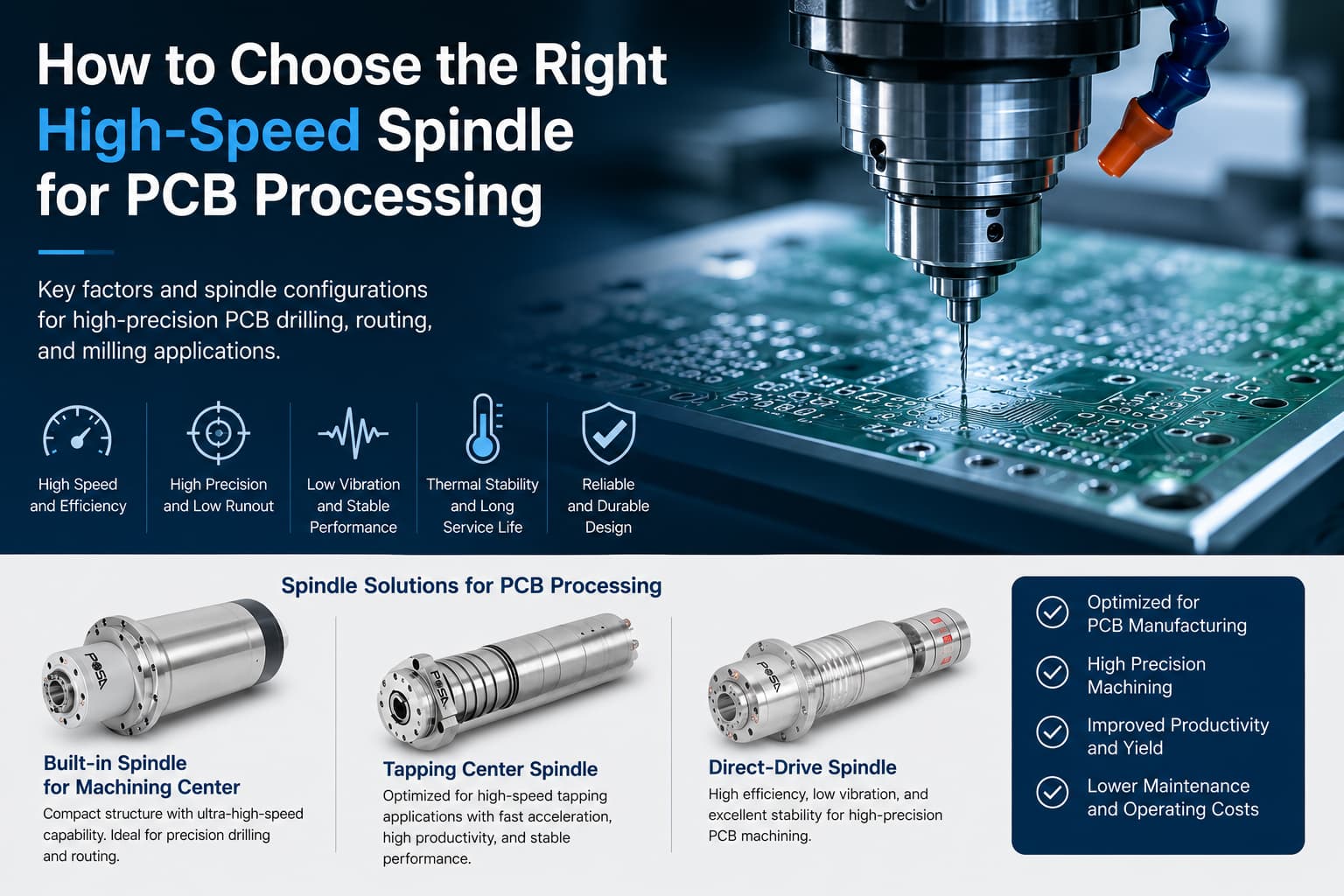
At POSA Machinery, several spindle configurations from our Spindle for Machining Center series are commonly applied in PCB processing applications.
Built-in spindles feature a compact motor-integrated structure that supports ultra-high-speed operation with reduced vibration. Their compact design and high rotational stability make them suitable for precision PCB drilling and routing applications that require excellent machining accuracy.
Tapping center spindles are designed for high-speed machining environments that demand fast acceleration, efficient tool changes, and stable machining performance. These spindles are suitable for PCB processing machines requiring high productivity and continuous operation.
Direct-drive spindles provide efficient power transmission with reduced mechanical loss and low vibration characteristics. Their stable rotational performance and fast response make them suitable for high-speed PCB machining applications requiring precision and consistency.
Selecting the appropriate spindle configuration depends on factors such as machining speed, tool diameter, workpiece material, production volume, and machine structure. A properly selected spindle system helps improve machining stability, processing efficiency, and long-term equipment reliability.
From POSA’s experience, the first three categories in our Spindle for Machining Center series—including built-in spindles, direct-drive spindles, and belt-driven spindles—can all be applied in PCB processing industries depending on machining requirements.
Selecting the appropriate spindle configuration depends on factors such as:
A properly selected spindle system helps improve machining stability, production efficiency, and long-term equipment reliability.
At POSA Machinery, we focus on developing spindle systems that provide:
Our spindle solutions are designed to support modern manufacturing industries that demand both precision and productivity, including PCB processing applications.
Choosing the right high-speed spindle for PCB processing requires careful evaluation of machining speed, accuracy, vibration control, thermal stability, and spindle configuration.
As PCB manufacturing continues to evolve toward higher precision and smaller component sizes, spindle performance will remain one of the key factors affecting machining quality and production efficiency.
From POSA’s perspective, a well-designed spindle system not only improves machining performance but also helps manufacturers maintain long-term operational stability and productivity in demanding PCB processing environments.
Looking for a reliable high-speed spindle solution for PCB processing applications?
Explore POSA’s Spindle for Machining Center series or contact us to discuss your machining requirements with our engineering team.
In our next article, we will explore the differences between built-in, direct-drive, and belt-driven spindles, and how each configuration affects machining performance in high-speed applications.